 celebyachts.com
The maritime broadsheet of public waters · Register current through 27 Jul 2026
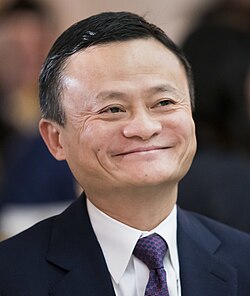
Chinese business magnate and investor (born 1964)
Ma Yun, also known as Jack Ma, is a Chinese businessman and philanthropist. He is the founder of the Jack Ma Foundation, and co-founder of Alibaba Group and Yunfeng Capital. He is one of the richest men in China with a net worth of approx US$27.5 billion.
Ma was born in Hangzhou, Zhejiang, on 10 September 1964. He became interested in learning the English language as a young boy and began practicing it with English-speaking visitors who frequented the Hangzhou International Hotel. At the age of 12, Ma bought a pocket radio and began listening to English radio stations frequently. For nine years, Ma rode 27 km (17 miles) on his bicycle every day to work as a tour guide of Hangzhou for foreigners in order to practice his English. He became pen pals with one of those foreigners, who nicknamed him "Jack" because he found it hard to pronounce his Chinese name. When Ma was 13 years old, he was forced to transfer to Hangzhou No. 8 Middle School as he kept getting in fights. In his primary school days, Ma struggled academically, and it took two years for him to gain acceptance at an ordinary Chinese high school, as he only got 31 points in mathematics on the Chinese high school entrance exam. In 1980, while he was riding his bike to practice English with tourists, he met Ken Morley, who was traveling with his family with the Australia-China Friendship Society. Ken's son, David, became pen pals with Ma and kept in touch after the family left China. Years later, the Morleys hosted Ma in Australia, changing the course of his life completely. Ma later said: "Those 29 days in Newcastle were crucial in my life. Without those 29 days, I would never have been able to think the way I do today." In 1982, at the age of 18, Ma failed the Chinese college entrance exam on his initial attempt, obtaining only 1 point in mathematics. Afterwards, he and his cousin applied to be waiters at a nearby hotel. His cousin was hired, but Ma was rejected on the grounds that he was "too skinny, too short, and in general, protruded a bad physical appearance that may have potentially ended up hurting the restaurant's image and possibly tarnishing its reputation." In 1983, Ma failed his college entrance exam for the second time. However, his math score improved, increasing from his previous attempt to 19 points. The following year, Ma remained relentlessly determined to pursue higher education despite strong opposition from his family, who wanted him to choose a different career path as an alternative option. Undeterred, he decided to take the entrance exam a third time in 1984. On his third attempt, Ma scored 89 points on the math section, marking a significant improvement from his previous two attempts. Nonetheless, the minimum benchmark entrance requirement would have rendered Ma ineligible to be accepted into university, since his score was five points below the standardized minimum threshold for him to qualify. However, Ma's academic fortunes changed since the enrollment target for prospective majors in Hangzhou Normal University's Department of English was not met, as some prospective students had the opportunity to be accepted and promoted into it, with Ma himself having ended up being promoted to the department's foreign langua
Ma is the founder of the Jack Ma Foundation, a philanthropic organization focused on improving education, the environment and public health. In 2008, Alibaba donated $808,000 to victims of the Sichuan earthquake. In 2009 Ma became a trustee of The Nature Conservancy's China program, and in 2010 he joined the global Board of Directors of the organization. In 2015, Alibaba launched a nonprofit organization, Alibaba Hong Kong Young Entrepreneurs Foundation, which supports Hong Kong entrepreneurs to help them grow their businesses. In the same year, the company funded the rebuilding of 1,000 houses damaged by the earthquake-hit in Nepal, and raised money for another 9,000. In 2015 he also founded the Hupan School, a business school. In September 2018, Ma started the Jack Ma Foundation and announced that he would retire from Alibaba to pursue educational work, philanthropy, and environmental causes. In 2019, Forbes named Ma in its list of "Asia's 2019 Heroes of Philanthropy" and awarded him the Malcolm S. Forbes Lifetime Achievement Award for his work supporting underprivileged communities in China, Africa, Australia, and the Middle East. In 2020, in response to the COVID-19 pandemic, the Alibaba Foundation and Jack Ma Foundation launched various initiatives, some of which involved donating medical supplies to the United States as well as various countries in Asia, Africa, and Europe.
In May 2025, Time Magazine chose Jack Ma as one of its Time100 Philanthropy honorees for his contributions through his foundation, during COVID-19, and for his rural teacher initiative. He is also dedicated to climate preservation, and as a previous chairman of China's Natural Conservancy Council, he has on many occasions explained how making money in ways that do not harm the planet is important. In 2021, Alibaba pledged to become carbon neutral in its operations by 2030. In 2024, Alibaba Group and its B2B e commerce site also pledged to reduce packaging materials using AI and pushed for reusing practices to increase conservation.
According to Ma's autobiographical speech, after graduating from Hangzhou Normal University in 1988, Ma applied for 31 different odd entry-level jobs and was rejected for every single one. "I went for a job with the KFC; they said, 'you're no good'", Ma told interviewer Charlie Rose. "I even went to KFC when it came to my city. Twenty-four people went for the job. Twenty-three were accepted. I was the only guy [rejected] ...". During this period, China was nearing the end of its first decade following Deng Xiaoping's reform and opening up. In 1994, Ma heard about the Internet and also started his first company, Hangzhou Hope Translation Agency (杭州海博翻译社), and launched its website the next year. In early 1995, he travelled abroad to the United States on behalf of the Hangzhou municipal government with colleagues who had helped introduce him to the Internet. Although he found information related to beer from many countries, he was surprised to find none from China. He also tried to search for general information about China and again was surprised to find none. So he and his friend created an "ugly" website pertaining to information regarding Chinese beer. He launched the website at 9:40 am, and by 12:30 pm he had received emails from prospective Chinese investors wishing to know more about him and his website. This was when Ma realized that the Internet had something great to offer. In April 1995, Ma, along with his business partner He Yibing, a computer instructor, opened his second company, Hangzhou Hope Computer Services (杭州海博网络公司). One of China's earliest Internet start-ups, the company ran a website, China Pages (中国黄页), as an online yellow page service. On 10 May 1995, the pair registered the domain chinapages.com in the United States. Within a span of three years, China Pages cleared approximately 5,000,000 RMB in profit which at the time was equivalent to US$642,998 (approximately $1.18 million today).
Ma began building websites for Chinese companies with the help of friends in the United States. He said that "The day we got connected to the Web, I invited friends and TV people over to my house", and on a very slow dial-up connection, "we waited three and a half hours and got half a page", he recalled. "We drank, watched TV and played cards, waiting. But I was so proud. I proved the Internet existed".From 1998 to 1999, Ma headed an information technology company established by the China International Electronic Commerce Center, a department of the Ministry of Foreign Trade and Economic Cooperation. In 1999, he quit and returned to Hangzhou with his team to establish Alibaba, a Hangzhou-based business-to-business marketplace site in his apartment with a group of 18 friends. He started a new round of venture development with 500,000 yuan. In October 1999 and January 2000, Alibaba won a total of a $25 million foreign venture seed capital from the American investment bank, Goldman Sachs and the Japanese investment management conglomerate SoftBa
Biographical detail compiled from Wikipedia and Wikidata, which are edited openly and may be incomplete or out of date. Fleet data is our own. Source →