 celebyachts.com
The maritime broadsheet of public waters · Register current through 27 Jul 2026
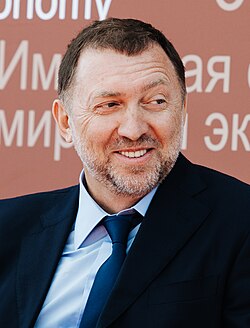
Russian businessman (born 1968)
Oleg Vladimirovich Deripaska is a Russian oligarch and billionaire. Deripaska began his career as a metals trader after the breakup of the Soviet Union. He used accumulated funds from trading to acquire stakes in the Sayanogorsk aluminium smelter from a consortium of businessmen who privatized it in the aftermath of the collapse of the Soviet Union. The Sayanogorsk aluminium smelter served as the foundation of what later became the world's largest aluminium company Rusal.
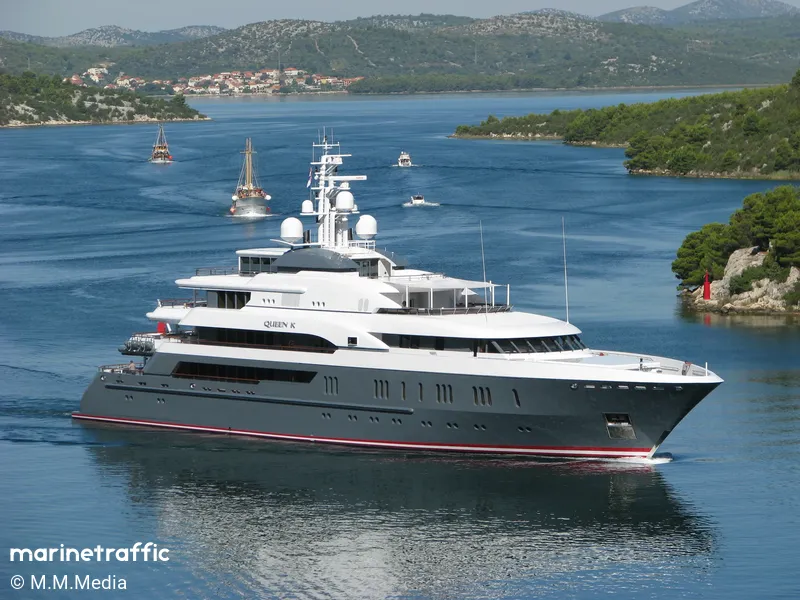 Lürssen
72.6 m · 238 ft · 2004 · Cook Islands
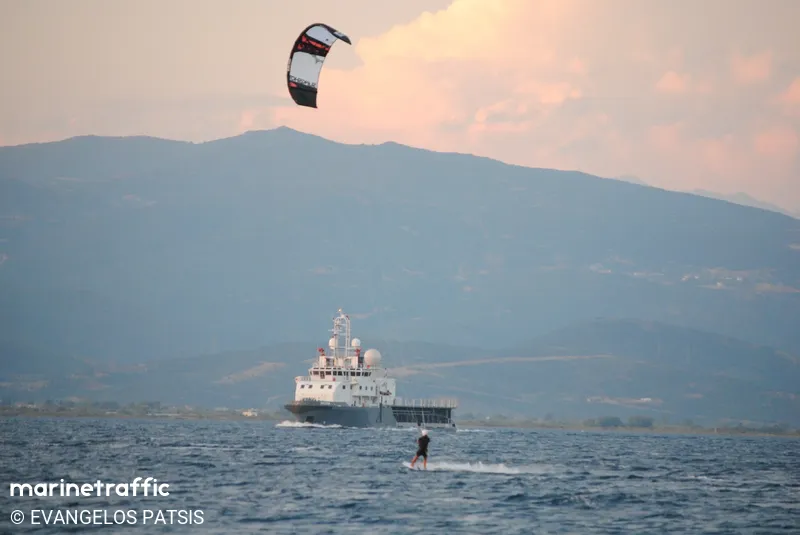 Boustead Langkawi Naval Shipyard (MY); conv. OSV
60 m · 197 ft · 2006 · Cook Islands
Deripaska was born to a Jewish family in Dzerzhinsk, Nizhny Novgorod Oblast, Soviet Russia and grew up in Ust-Labinsk, Krasnodar Krai. His parents came from Kuban. Deripaska grew up on the family's small farm, where from the age of 5 or 6, he learned how to live off the land from his grandparents, who primarily raised him after his widowed mother, an engineer, had to leave to find work. Deripaska credits his grandparents for teaching him the discipline of hard work along with farming. Both his grandfathers fought in the Second World War. His maternal grandfather returned to Russia after the war ended. His paternal grandfather Timofey Deripaska (1918-1945) – an ethnic Ukrainian – was killed in battle and buried in a mass grave in Austria — in his memory, Deripaska built a Russian Orthodox church in the town Laa an der Thaya. Deripaska's first job was at the Ust-Labinsk plant where his mother worked. At age 11, he became an electrician's apprentice doing maintenance on electrical motors. His talent for math allowed him to enroll at the physics faculty of Moscow State University in 1985. One year into his studies, he was conscripted into the armed forces and served in the Soviet Strategic Missile Forces in the Trans-Baikal district of Siberia from 1986 to 1989. In 1993, Deripaska graduated with honors in physics from Moscow State University; however, the collapse of the Soviet Union greatly reduced academic funding, making it impossible for him to continue his studies as a theoretical physicist. There were no available stipends or grants for students. "We had no money. It was an urgent and practical question every day. How do I earn money to buy food and keep studying?" he recalls. In 1996, he earned a master's degree from the Plekhanov University of Economics.
Oleg Deripaska sits on the board of trustees of the Bolshoi Theatre, and has financed ballet performances like Flames of Paris, La Sylphide, and Paquita as well as operas like The Legend of the Invisible City of Kitezh and the Maiden Fevroniya, Carmen, and Wozzeck. In 1998, Deripaska established a charitable foundation in Russia, Volnoe Delo. The fund supports initiatives in Russia aimed at developing education and science, preserving spiritual and cultural heritage, and improving standards in public health. Since 1998, Deripaska claims to have invested in more than 500 charity programs in 50 regions of Russia. Volnoe Delo has supported research activities in the 2,550-year-old city of Phanagoria since 2004. More than $10 million has been allocated to Phanagoria fieldwork over the past 14 years. Today, Phanagoria is one of the best-equipped archeological sites in Russia and has a scientific and cultural center, equipment and technology for above-ground and underwater excavation, as well as a team of specialists involved in the excavation process. In 2014, Volnoe Delo foundation launched a programme for students' early career guidance and professional training—JuniorSkills. The first, pilot, championship on professional skills, JuniorSkills Hi-Tech, was held in the Urals city of Yekaterinburg in 2014, part of the nationwide championship on cross-industry blue-collar professions in high-tech "WorldSkills". In 2020 during the pandemic of COVID-19 it bought new ambulances and sent them to twelve Russian towns in Siberia and the Urals. Deripaska was a member of the International Council at Harvard University's Belfer Center for Science and International Affairs. In 2017, during the West African Ebola virus epidemic Deripaska personally initiated construction of the Centre for Epidemic and Microbiological Research and Treatment in the Guinean Kindia province. The centre was designed and constructed by RUSAL specialists with the assistance of Rospotrebnadzor scientists (RUSAL has invested $10 million). In February 2014, Deripaska financed the construction of makeshift kennels to house stray dogs that had been abandoned by construction workers after completing work on the Sochi Olympic Village. In October 2015 Deripaska called for governments not to agree to the Paris climate accords since they lacked legally-binding mechanisms and arguing that countries like India and China needed to contribute more to avoid competition problems. In 2020, during the pandemic he donated money to construct hospitals in Siberia. As part of a public relations campaign, he said in April 2021 that Rosstat (Federal State Statistics Service) data showing that there are 17.8 million poor people living below the country's subsistence minimum was wrong, and that the correct number was about 80 million. Deripaska criticized the Russian invasion of Ukraine on several occasions. On 20 December 2022, a Russian court had ordered the seizure of a luxury hotel complex in Sochi worth $1 b
Deripaska was married to Polina Yumasheva, the daughter of Boris Yeltsin's top adviser Valentin Yumashev and stepdaughter of Yeltsin's daughter Tatyana. While Yeltsin was president, Deripaska's close ties put him in Yeltsin's inner circle, dubbed "The Family". Deripaska and Yumasheva were married from 2001 to 2018. The Deripaskas have two children: a son, Pyotr (born 2001), and daughter, Maria (born 2003). Deripaska practices yoga, swimming, horseback riding, and hiking. At his home near Moscow, he has seven horses and six dogs. In March 2018, it was reported that Deripaska had successfully acquired Cypriot citizenship in 2017, under that country's golden visa rule, which generates billions in revenue for the island nation. According to documents seen by The Guardian, Deripaska's first attempt to become a citizen of a country in the EU was unsuccessful because of a preliminary inquiry into his activities in Belgium. This inquiry was dismissed in 2016. In 2009, Deripaska's ranking fell to No. 164, with Forbes stating: "[H]e may not withstand collapsing markets and heavy debts". In 2010, his estimated $US10.7 billion fortune allowed him to rise to No. 57 of the World's Billionaires list. According to Forbes magazine, he removed the heads of his two largest companies and personally negotiated with the Russian government, banks, and other creditors to restructure his loan obligations. Deripaska himself in 2007 was reported to have consistently said that the estimate of his wealth was exaggerated, that it did not completely account for the amount of debt he incurred, and that he should be ranked far below the top ten on the list of the Russian billionaires. Forbes estimated his fortune at $US3.3 billion in 2015, $5.2 billion in 2017, $3.3 billion in 2019, $3.8 billion in 2021, $2.5 billion in 2023, In July 2025, Forbes estimated his net worth to be $US4.1 billion. Deripaska's Cypriot−registered company Edenfield Investments acquired the Grade II listed Hamstone House in the St George's Hill district of Weybridge, Surrey, in 2001. Since 2006, Deripaska has owned the Haft mansion near Embassy Row in Washington, D.C., through a company incorporated in Delaware. He owns a mansion in Belgravia.
At the age of 25, teaming up with fellow physicists, engineers and rocket scientists, Deripaska set up his first metal trading company, VTK. He adopted a systematic, scientific approach to commodity trading. "I represented companies that were buying and selling raw materials", Deripaska said. Deripaska undertook export arbitrage, buying metal at low Russian prices and selling it abroad at significantly higher international market prices. Deripaska traded primarily through the Baltic state of Estonia, as the Russian system of export licenses was in disarray. "I started my business at an unusual moment in history. The country in which I was born and raised had disappeared, although the new country was not fully formed. The first one gave me an excellent education; the second one gave me the chance of success", Deripaska recalled in an interview with Metal Bulletin. He used nearly all his arbitrage and trading profits to acquire his initial package of shares in the Sayanogorsk aluminium smelter in Southern Siberia. In 1994, Deripaska became director general of the plant at the age of 26. In 1997, he founded Sibirsky (Siberian) Aluminium Group, which in 2000 merged with Roman Abramovich's Millhouse Capital to create RUSAL. In 2003, businesses led by Deripaska increased their stake in those companies under common management to 75% by acquiring half of the interest managed by Millhouse Capital. In 2004, the consolidation of RUSAL's ownership by companies related to Deripaska was completed with the acquisition of the remaining 25% equity interest in RUSAL managed by Millhouse Capital. Deripaska was named businessman of the year in 1999, 2006, and 2007 by Vedomosti, a Russian business daily. RUSAL went on to become the largest aluminium producer in the world, until the China Hongqiao Group surpassed it in 2015. In 2010, under Deripaska's leadership, Rusal became the first Russian company to be listed on the Hong Kong Stock Exchange.
In 2011, Deripaska established Kuban Agroholding, a 75,000-hectare agribusiness in the Krasnodar region. The company integrates two dairy farms, а 16,000 pig capacity breeding complex, three elevators with non-recurrent grain storage capacity of more than 270,000 tonnes, three grain processing plants, a sugar factory and the Sunrise horse breeding farm, specializing in the breeding of English thoroughbred horses. It is one of the top-20 largest agribusinesses and top-5 most efficient land users in Russia. Kuban Agroholding is one of the few agrocompanies in Russia involved in embryo transfer technology that allows for the reproduction of high-yielding milk cows using less-productive surrogates. The company has gained significant media attention for its corn-seeding program, deploying several dozen corn brands selected by its genetic specialists. According to Forbes in June 2019, Deripaska's Kuban land bank was the fourteenth largest in Russia.
In 2009, Deripaska had been interrogated as a witness in Spain and England and by the FBI about money laundering, he was never charged with any crimes. On 25 January 2010, the Financial Times published a story titled "Rusal: A lingering heat" exploring Deripaska's business relations with Sergei Popov and Anton Malevsky, alleged heads of Russian organized crime groups. Deripaska has accused Michael Chernoy of using Malevsky and the Izmailovskaya syndicate to extort US$250 million from him as part of a protection racket. However, Deripaska has himself been accused of having similar links to Malevsky, who, with his brother Andrei, owned a 10% stake in Deripaska's company. Deripaska denies the claims. In 2011, Deripaska and Iskander Makhmudov (head of UGMK) were asked by Spanish police to answer questions in relation to a money-laundering enquiry. In November 2011, Spain's High Court sent the criminal cases against Deripaska to the Russian General Prosecutor's office because the root of the cases is Russian.
Australian sanctions On 18 March 2022, Australia added Deripaska to its sanctions list.
Canada sanctions Deripaska was sanctioned by Canada under the Special Economic Measures Act (S.C. 1992, c. 17), in relation to the Russian invasion of Ukraine, for Grave Breach of International Peace and Security.
European Union sanctions On 8 April 2022, the EU added Deripaska to its sanctions list, freezing his assets and imposing a travel ban in all member states. On 30 November 2022, Deripaska filed an appeal against the EU's decision to sanction him. Ukraine has claimed that assets belonging to Deripaska had been moved into the name of Siegfried Wolf, an Austrian citizen paid by Deripaska to avoid sanctions.
UK sanctions Following the 2022 Russian invasion of Ukraine, Deripaska was sanctioned by the British government. This involved freezing his assets and a travel ban. Deripaska-linked UK company Terra Services Ltd. was raided in December 2018.
U.S. sanctions
In April 2018, the United States imposed sanctions on Deripaska and 23 other Russian tycoons and officials. The statement of the United States Department of the Treasury said that Deripaska "ha[d] been accused of threatening the lives of business rivals, illegally wiretapping a government official, and taking part in extortion and racketeering". In May 2018, it was reported that Deripaska had to return three private jets owned by Credit Suisse and Raiffeisen. In October 2018 the U.S. Treasury announced that it had extended until 12 December a deadline for the full imposition of sanctions against Rusal and its parent company En+ Group, pending the review of the proposals presented by En+ Group to the U.S. government that would see Deripaska reduce his stake in En+ to below 45 per cent from around 70 per cent. In January 2019 the U.S. Treasury lifted the sanctions on companies formerly controlled by Deripaska. Sanctions on Deripaska himself remained in effect. In April 2019, the U.S. Treasury D
Biographical detail compiled from Wikipedia and Wikidata, which are edited openly and may be incomplete or out of date. Fleet data is our own. Source →