 celebyachts.com
The maritime broadsheet of public waters · Register current through 27 Jul 2026
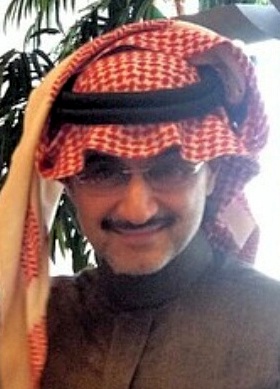
Saudi Arabian royal, businessman and investor (born 1955)
Prince Al Waleed bin Talal Al Saud is a Saudi Arabian billionaire businessman, investor, and a House of Saud royal. In 2008, he was listed on Time magazine's Time 100, an annual list of the hundred most influential people in the world. Al Waleed is a grandson of Abdulaziz, the first king of Saudi Arabia, and of Riad Al Solh, Lebanon's first prime minister.
Al Waleed bin Talal was born in Jeddah on 7 March 1955 to Prince Talal bin Abdulaziz and Mona El Solh. His father was Saudi Arabia's finance minister during the early 1960s, before he went into exile due to his advocacy for political reform. Al Waleed's paternal grandparents were King Abdulaziz and Munaiyir. His grandmother, an Armenian, was presented by the emir of Unayzah to King Abdulaziz in 1921, when she was 12 years old and Abdulaziz was 45. His maternal grandparents were Riad Al Solh, the first prime minister of Lebanon, and Fayza Al Jabiri, the sister of Syrian Prime Minister Saadallah al-Jabiri. Al Waleed's parents separated when he was seven, and he lived with his mother in Lebanon. He first attended Pinewood College in Beirut. As a boy, he ran away from home for a day or two at a time, sleeping in unlocked cars, before attending the King Abdulaziz Military Academy in Riyadh. In 1974, he returned to Lebanon, attending the Choueifat School and then Manor School. Al Waleed received a bachelor's degree in business administration from Menlo College in California in 1979, finishing in two-and-a-half years, and a master's degree with honors in social science from the Maxwell School of Citizenship and Public Affairs at Syracuse University in 1985, finishing in eleven months.
In July 1997, Al Waleed invested $10 million with the Palestinian Investment and Development Company (PADICO), and then helped cofound the Jerusalem Development and Investment Company (JEDICO). In 2002, Al Waleed donated $500,000 to help fund the George Herbert Walker Bush scholarship at Phillips Academy in Andover, Massachusetts. He donated £18.5 million to Palestinian families during a TV telethon ordered by Saudi King Fahd to help relatives of Palestinians after Israeli operations in the West Bank city of Jenin. In 2004, he contributed $17 million to victims of the 2004 Indian Ocean earthquake and tsunami. On 1 July 2015, Al Waleed held a press conference announcing his intention to donate $32 billion to philanthropic causes. He said that the funds would be used for humanitarian projects such as the empowerment of women and youth, disaster relief, disease eradication and building bridges of understanding between cultures.
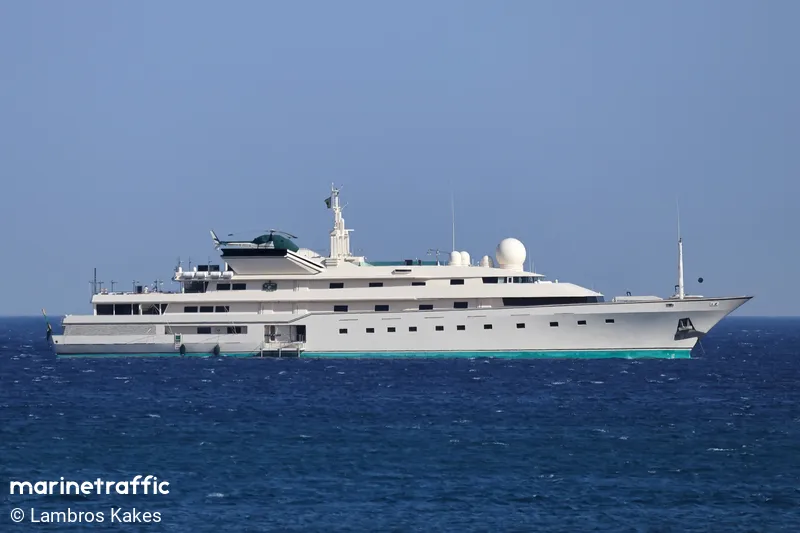
Al Waleed owns the 65th-largest private yacht in the world, the 85.9-metre (282 ft) Kingdom 5KR (originally built as the Nabila for Saudi arms dealer Adnan Khashoggi in 1979). In 1983, owned by Khashoggi, it appeared as the Flying Saucer (the yacht of James Bond's villain, Largo) in Never Say Never Again. It was sold to Donald Trump, who renamed her the Trump Princess. Al Waleed bought the yacht after Trump experienced financial problems in the late 1980s. Al Waleed ordered a yacht known as the New Kingdom 5KR, about 173 metres (568 ft) long with an estimated cost of over $500 million. The yacht is designed by Lindsey Design, and its design was delivered in late 2010. He owns several aircraft converted for private use: a Boeing 747, an Airbus A321 and a Hawker Siddeley 125. Al Waleed was the first individual to purchase an Airbus A380 and was due to take delivery of it in the spring of 2013, but it was sold before delivery. Among his assets are a 95-percent stake in Kingdom Holding Company; 91-percent ownership of Rotana Video and Audio Visual Company; 90-percent ownership of the Lebanese Broadcasting Corporation; seven-percent ownership of News Corporation; about six-percent ownership of Citigroup, and a 17-percent ownership of Al Nahar and a 25-percent ownership of Ad-Diyar (two daily newspapers published in Lebanon). Al Waleed topped the first Saudi Rich List in 2009, with assets of $16.3 billion.
Al Waleed began his business career in 1979 after graduating from Menlo College. He returned to Saudi Arabia, which was in the midst of the 1974–85 oil boom. Operating from a small, four-room cabin in Riyadh and $30,000 start-up money provided by his father, Al Waleed formed Kingdom Establishment in 1980. When that money ran out in a few months, he secured a $300,000 loan from the Saudi American Bank, partly owned by Citibank. Rather than taking a commission for facilitating contracts as the legally required middleman, Al Waleed insisted on a stake in the project. His first success was in 1982, partnering with a South Korean construction company, and from then on, his commissions were used to fund his real estate deals. In his own words, "All the money I used to get from this construction I would plough back into real estate, and in the stock market, both." After the end of the Saudi oil boom, Al Waleed acquired the underperforming United Saudi Commercial Bank (USCB). Through mergers with Saudi Cairo Bank (SCB), forming United Saudi Bank (USB), and the Saudi American Bank (SAMBA), it became a leading Middle Eastern bank. The hostile takeover of USCB in 1986, the merger with SCB in 1997, and the merger of USB with SAMBA in 1999, were the first of their kind in the Kingdom. He then secured a majority in Al-Azizia Panda, merging it with the Savola Group, and took over National Industrialization Company. By 1989, his net worth was $1.4 billion, and included stakes in Canary Wharf, Four Seasons Hotel Group, and News Corporation. When Al Waleed turned to the international market, he focused on "established brands going through hard times," as Riz Khan puts it. Al Waleed would do his homework, and then wait for the proper purchase entry point. He invested about $250 million in Chase Manhattan, Citigroup, Manufacturers Hanover, and Chemical Bank. After seven months, he sold his stakes in the other banks and concentrated on investing in Citicorp, acquiring 4.9 percent of the bank. Though the worst performing bank of the four, Al Waleed considered Citicorp had the best potential. In September 1990, Citibank was undercapitalized due to real estate credit losses and exposure to Latin America debt, prompting a need for a capital reserve. By November, they were actively seeking investors. Based on his banking experience in the Kingdom, Al Waleed agreed in January 1991 to invest $590 million, about half his accumulated wealth, in a five-year convertible security paying 11 percent interest. By Feb., that took his total investment in Citicorp to $797 million, or about 15 percent of the company. Though he had received a Federal Reserve temporary waiver to own such a large portion of the company, Al Waleed sold enough shares in 1993 to get below the 10 percent threshold. Still, he was the largest shareholder in the largest US financial institution at the time. Yet, in Alwaleed's words, "It is not a relationship, it's an alliance. We are there forever with them." Sa
Al Waleed has been married and divorced four times. His first marriage was in 1976, at the age of 19 to his cousin, Princess Dalal bint Saud, a daughter of King Saud. They have two children, Prince Khaled, born on 21 April 1978 and Princess Reem, born on 20 June 1982. Al Waleed and bint Saud later divorced in December 1994. In 1996, Al Waleed married Iman Sudairi, but the marriage lasted approximately a year. After divorcing her, Al Waleed married Kholood Al Anazi, in 1999. They were divorced in 2004. Al Waleed's fourth wife was Ameera al-Taweel; after about six years of marriage, they divorced in 2014. In an interview, he said: "Yes, I announce it through Okaz—Saudi Gazette for the first time. I have officially separated from Princess Ameera Al-Taweel, but she remains a person that I have all respect for." He is a supporter of Al Hilal SFC and a Platinum Supporter Member of the club. In September 2024, he donated 300 million Saudi riyals to the club.
Biographical detail compiled from Wikipedia and Wikidata, which are edited openly and may be incomplete or out of date. Fleet data is our own. Source →